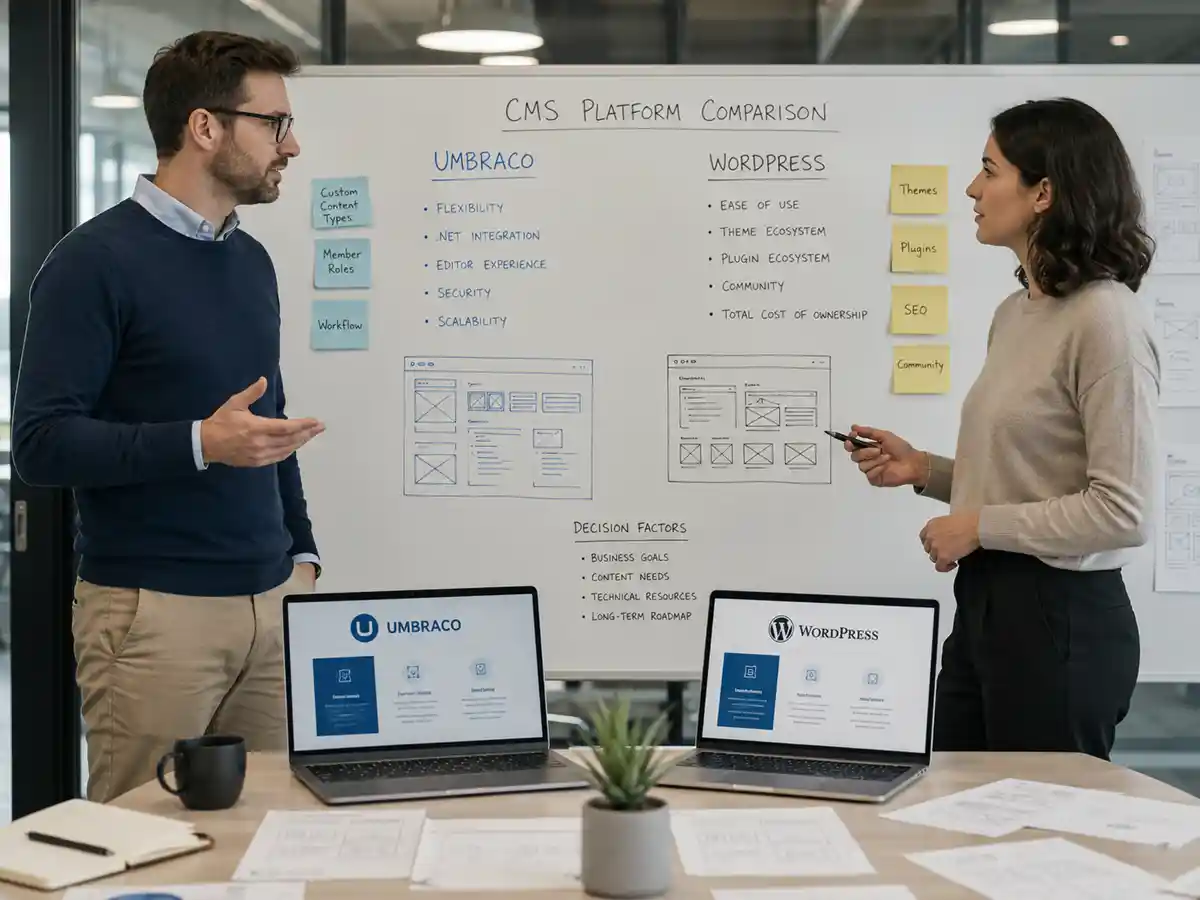
Why We Recommend Umbraco Over WordPress for Business Websites
For many businesses, the first question when planning a new website is simple: Should we use WordPress?
It is a fair question. WordPress is everywhere. It is familiar, flexible, widely supported, and used by millions of websites. According to W3Techs, WordPress powers a large share of websites worldwide and holds a big part of the CMS market. These numbers can change, so it is best to check the primary source before publishing.
This market share is important because it means WordPress has a huge ecosystem. There are many themes, plugins, developers, hosting options, tutorials, and support resources. For small businesses, bloggers, simple brochure sites, and groups with limited budgets, WordPress can be a practical choice.
This article is not saying WordPress is useless.
We are, however, asking whether WordPress is always the best option for a serious business website.
In our view, the answer is no.
For many business websites—especially those needing strong security, custom features, structured content, scalability, accessibility, performance, and long-term maintenance—we often recommend Umbraco instead.
WordPress Is Popular, But Popular Does Not Always Mean Best
WordPress became popular for good reasons. It made publishing easier. It gave non-technical users control. It created a huge plugin ecosystem. It allowed people to build websites without having to start from scratch. In many ways, WordPress helped democratize the web.
However, popularity can also bring challenges. Since WordPress is so widely used, it is a bigger target. Many WordPress sites rely on plugins, and each plugin adds another dependency. When sites are built from many themes, plugins, page builders, and add-ons, they can become harder to maintain over time.
This does not mean WordPress is always insecure. That would be an overstatement. A well-built, well-hosted, and well-maintained WordPress site can be secure and effective. But if a WordPress site has too many plugins, outdated themes, weak hosting, and is not updated regularly, it can quickly become a problem.
The real risk is not WordPress itself, but how it is often used.
The Plugin Problem
One of WordPress’s biggest strengths is also one of its biggest weaknesses. Plugins make WordPress incredibly flexible. Need a form? There is a plugin. Need SEO tools? There is a plugin. Need caching, galleries, redirects, ecommerce, multilingual support, analytics, popups, security scanning, or custom fields? There is probably a plugin for that, too.
This is convenient, but it can also make a website fragile. Each plugin adds more code that needs to be maintained. Plugins may depend on other developers, update cycles, compatibility layers, and security practices.
WordPress has a huge plugin ecosystem. The exact number changes, so it is best to check WordPress.org for the latest count before publishing. While this scale is helpful, it also means the quality of plugins can vary a lot.
Some plugins are excellent. Some are actively maintained by responsible developers. Some are essential to modern WordPress builds. Others are abandoned, bloated, poorly coded, duplicated, or installed for a single small feature that could have been implemented more cleanly.
This is how many WordPress websites become messy. It does not happen all at once; it happens over time. Plugins are added for forms, sliders, redirects, image optimization, custom blocks, security, SEO, caching, and accessibility fixes that should have been built in. Eventually, the website feels less like a custom platform and more like a collection of dependencies.
This can hurt performance, security, editing, upgrades, and overall confidence in the site.
Security Is About Architecture and Maintenance
Security is one of the main reasons we often prefer Umbraco. To be clear, WordPress can be secure if it is built and maintained well. However, WordPress’s popularity and reliance on plugins create a different security situation.
There have been many examples over the years of WordPress plugin vulnerabilities, compromised plugins, and sites being affected because an extension, theme, or installation was not properly maintained.
Security reporting over the years has shown that WordPress represents a very large share of hacked CMS websites. Sucuri’s 2018 Hacked Website Report put WordPress at 83% of CMS infections in 2017 and 90% in 2018 within the websites it analyzed. Those numbers are not universal current statistics, but they make the larger point clearly: when a platform is widely used and often extended through plugins, maintenance discipline matters enormously.
Our point is not that WordPress is automatically insecure. The point is that plugin governance, update discipline, hosting quality, monitoring, and ongoing maintenance matter. Without those things, WordPress sites can become vulnerable quickly.
With Umbraco, the model is often cleaner. Umbraco is an open-source CMS built on Microsoft’s .NET framework using ASP.NET Core. For businesses already invested in Microsoft technologies, Azure hosting, .NET development, enterprise security practices, or custom application development, that matters.
This means the CMS fits well into a more controlled development environment. Developers can build exactly what the website needs, instead of relying on many third-party add-ons. The result is usually a cleaner codebase, fewer unnecessary dependencies, and a site that is easier to manage for security and maintenance.
This does not mean Umbraco sites take care of themselves. They still need maintenance, but the architecture encourages a more thoughtful approach to building.
Umbraco Is Built for Custom Websites
WordPress can be customized in many ways, but it usually starts with themes, templates, plugins, and page builders. Umbraco takes a different approach from the beginning.
It is designed to give developers flexibility while giving editors a clean way to manage content. Umbraco describes itself as an open-source .NET CMS, and it is widely used for websites that need custom structure, editor control, integrations, and scalability. You may want to verify current usage numbers directly with Umbraco before publishing, as those figures can change.
This flexibility is important when a website is more than just a simple brochure. Many businesses need more than a homepage, about page, and contact form. They need structured service pages, location pages, team profiles, article systems, resource libraries, custom content types, integrations, accessibility built into the templates, strong SEO controls, and clear links between content, services, industries, and calls to action.
Umbraco is great for this kind of work. Instead of forcing content into a generic page builder, Umbraco lets the website be structured around the business. Developers can create content models that fit how the organization works. Editors can manage content without worrying about design choices that should be handled by the system.
This is a big advantage. A good CMS should not make editors act like designers. It should give them the right tools, structure, and guidance.
Better Editing Does Not Mean Unlimited Editing
One of the traps of modern web design is giving clients too much control. That may sound strange because clients should absolutely be able to manage content. They should be able to update pages, publish blogs, add resources, edit team profiles, adjust calls to action, and keep the website fresh.
But editors should not have to rebuild page layouts from scratch every time they make a change. In many WordPress builds, especially those using visual page builders, editors can get too much control over layouts. This might seem helpful at first, but over time, pages can become inconsistent. Spacing changes, colours drift, components get duplicated, accessibility suffers, and design systems break down.
Umbraco supports a more disciplined approach. Developers control the design system, while clients manage the content. This separation helps keep the website consistent and easy to update.
For businesses that value brand quality, accessibility, SEO, and long-term maintenance, this balance is important.
Performance Matters More Than Ever
Website performance impacts user experience, SEO, conversions, and accessibility. If a website is slow, it worsens every part of the digital experience.
WordPress performance depends a lot on how the site is built. A lean, well-developed WordPress site can perform well. But if the site is bloated with a heavy theme, too many plugins, large images, poor hosting, and messy scripts, it can perform badly. So the problem is not WordPress itself, but how it is built.
In our experience, Umbraco often leads to better performance because the site is usually custom-built for the business’s needs. The front end can stay lean, templates can be designed for speed, unnecessary plugins can be avoided, and hosting can be set up properly, especially with Microsoft Azure or other modern options.
Umbraco is built on ASP.NET Core and can be deployed in many environments, including the cloud. It is a good idea to check Umbraco’s documentation for the latest details before publishing, since technical information can change. The main point is that Umbraco gives developers control, which is important for performance, security, and scalability.
Umbraco Fits Modern Content Strategy
Websites are no longer just digital brochures. They are now content platforms.
A business website may need to support SEO, GEO, blogs, resource centres, landing pages, industry pages, case studies, team content, video libraries, events, integrations, multilingual content, and ongoing campaigns. That requires structure.
Publishing random pages and hoping Google understands them is not enough. Writing generic blogs is not enough. Having a page builder where every page stands alone is not enough. Modern content needs to be connected.
Services should link to industries. Industries should link to case studies. Case studies should link to people. Blog posts should support service pages. Location pages should improve local search results. FAQ content should answer real customer questions. Calls to action should match what users want.
Umbraco is strong here because it lets developers create structured content models that match the business strategy. This is important for SEO and GEO. If AI-powered search engines need clear, structured information, your CMS should help you organize it well.
Umbraco does that well.
WordPress Is Often Easier to Start, But Umbraco Can Be Easier to Live With
WordPress is often easier and cheaper to start with, which is one reason it is so popular. A small business can buy a theme, add some plugins, set up hosting, and launch a site quickly. For some organizations, this works well.
But the real cost of a website is not just the launch. It is also the cost to maintain, secure, improve, expand, and manage over time.
This is where Umbraco can be more appealing. A well-built Umbraco site might need more planning at the start and experienced .NET developers. It does not have the same instant theme and plugin marketplace as WordPress.
But this can be a strength. Since the site is designed for the business instead of being built from off-the-shelf parts, it is often easier to maintain, extend, keep consistent, secure, and scale.
This is not always the case, but it often is. For the business websites we build, this trade-off is usually worth it.
When WordPress Still Makes Sense
It is important to note that WordPress is not the right choice for every website. There are times when WordPress makes sense.
For example, WordPress works well for a simple blog, a low-budget brochure site, a small organization already familiar with WordPress, a business with in-house WordPress skills, a campaign site that needs to launch quickly, or a website where plugin-based features are fine, and the maintenance plan is clear.
In these situations, WordPress can be a practical choice. It is open source, widely supported, has a large community, and can be hosted almost anywhere. The point is not that WordPress has no place.
The real argument is that WordPress should not be the default just because it is familiar. A CMS should be chosen based on the business’s needs, website complexity, security needs, content strategy, technical setup, and long-term maintenance plan.
This is where Umbraco often stands out.
Why We Prefer Umbraco for Many Business Websites
At Air Whistle, we usually prefer Umbraco for business websites that need more control, stronger structure, better scalability, cleaner content management, and a more disciplined development process.
We like that Umbraco is open source and built on .NET. It gives developers flexibility without making content editors struggle. It supports structured content, custom workflows, integrations, and modern front-end methods. It can also be built cleanly without needing a long list of plugins.
We also like that it aligns with how serious organizations approach technology: secure, scalable, maintainable, and built for the long term.
This does not mean every site needs Umbraco. But more businesses should consider it, especially if they are frustrated with WordPress sites that feel fragile, bloated, inconsistent, or hard to maintain.
The Better Question: What Kind of Website Are You Really Building?
Choosing a CMS should not start with popularity. It should start with your purpose.
Are you building a simple site or a long-term digital platform? Do you need to launch quickly, or do you need a system that can grow? Do you need a theme or a custom content structure? Do you want to rely on plugins or have features built for your business? Do you need basic publishing or a website that supports SEO, GEO, accessibility, integrations, and future growth?
These questions matter because choosing the wrong CMS can cause problems for years. A website should not feel like a bunch of shortcuts. It should feel like an asset.
That is why we often recommend Umbraco. It is not that WordPress cannot work, but for many business websites, Umbraco provides a stronger foundation.
The Air Whistle View
At Air Whistle, we believe a website should be fast, secure, accessible, scalable, and easy to manage. It should be built for the business, not limited by a theme. It should support your content strategy and help search engines and real people find what they need.
It should give editors control without letting the design system break down. It should be something the business can grow with, not something people are afraid to update.
WordPress can be the right tool in some situations. But for many of the business websites we build, Umbraco is the better choice. It gives us more control, better structure, fewer unnecessary dependencies, and a framework that fits serious long-term digital work.
The best CMS is not always the most popular. It is the one that gives your business the strongest foundation. For many businesses, that foundation is Umbraco.